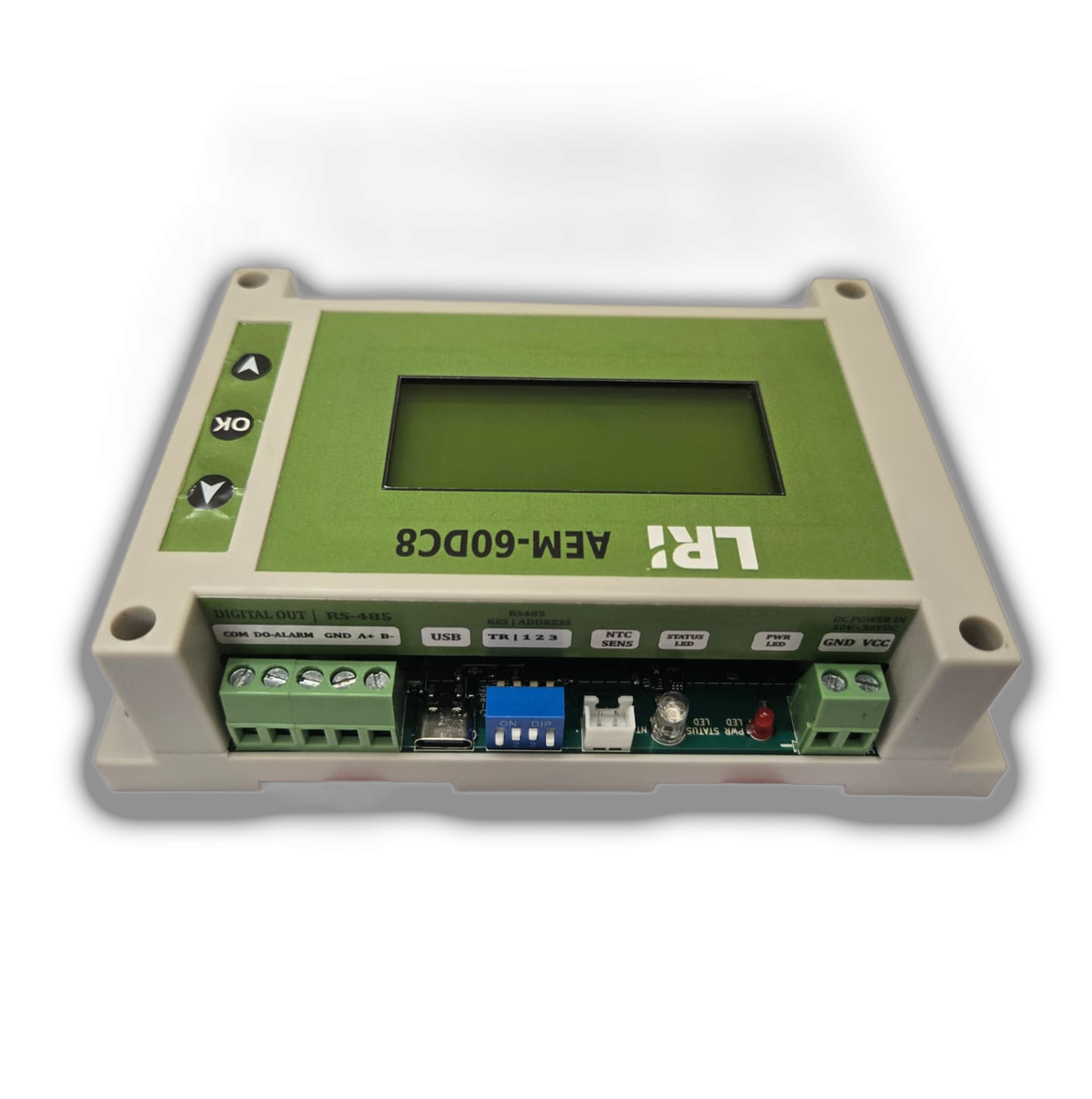
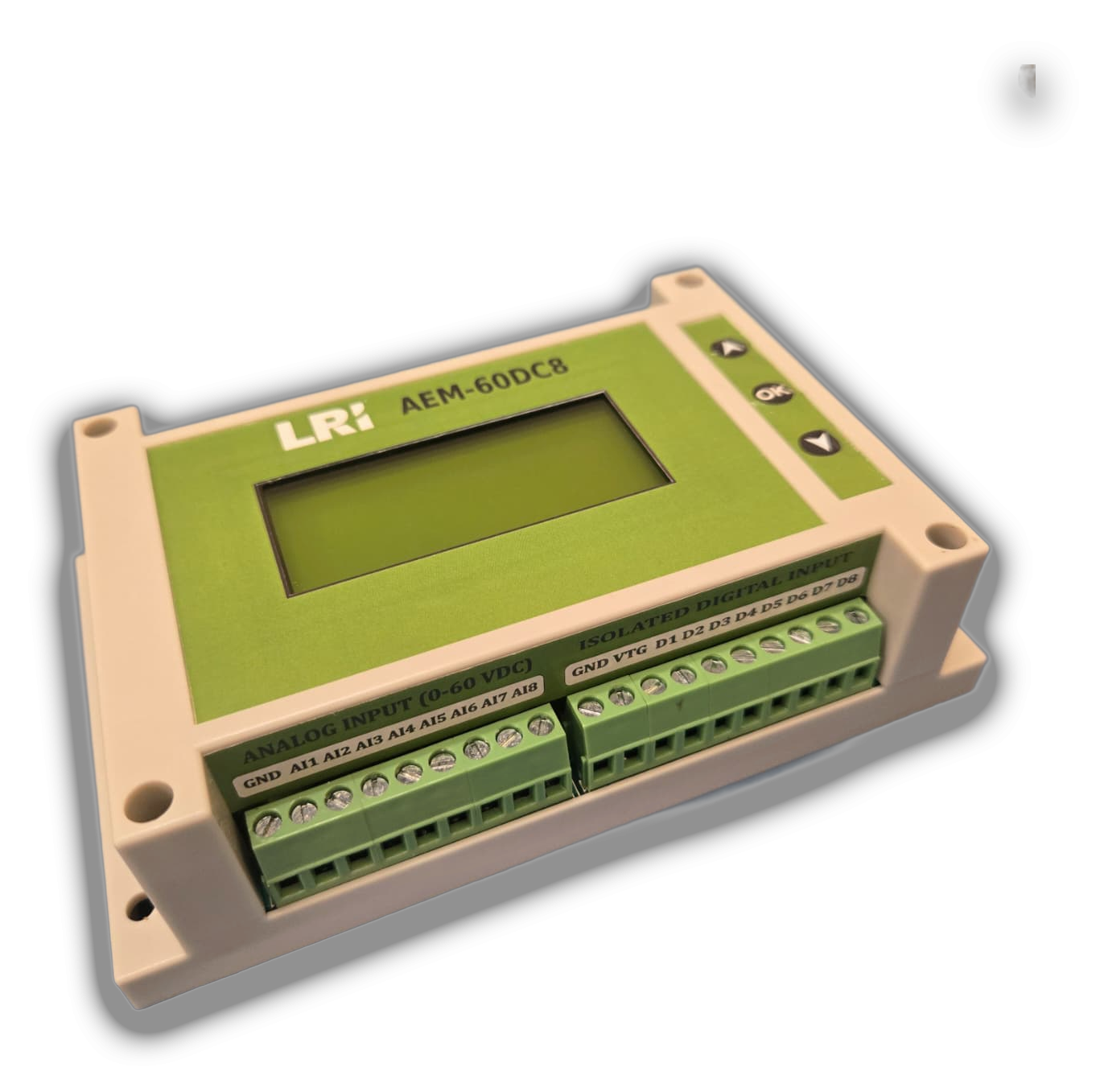
16x4 LCD Display
Local real-time readout of all eight channels with UP, DOWN and OK navigation keys.
Multichannel DC telemetry and supervision platform for critical power, industrial automation, and telecom infrastructure. 147 holding registers, Secure by Design, IIoT-ready.
Designed for industrial panels, battery banks, rectifiers and critical DC infrastructure. The LRI-AEM-60DC8 delivers eight independent measurement channels, opto-isolated digital inputs, configurable alarms and native SCADA/PLC integration over Modbus RTU.

Local real-time readout of all eight channels with UP, DOWN and OK navigation keys.
Integration with SCADA and PLCs from 4800 up to 115200 bps, ID via DIP switch.
Integrated bootloader for in-field firmware upgrades.
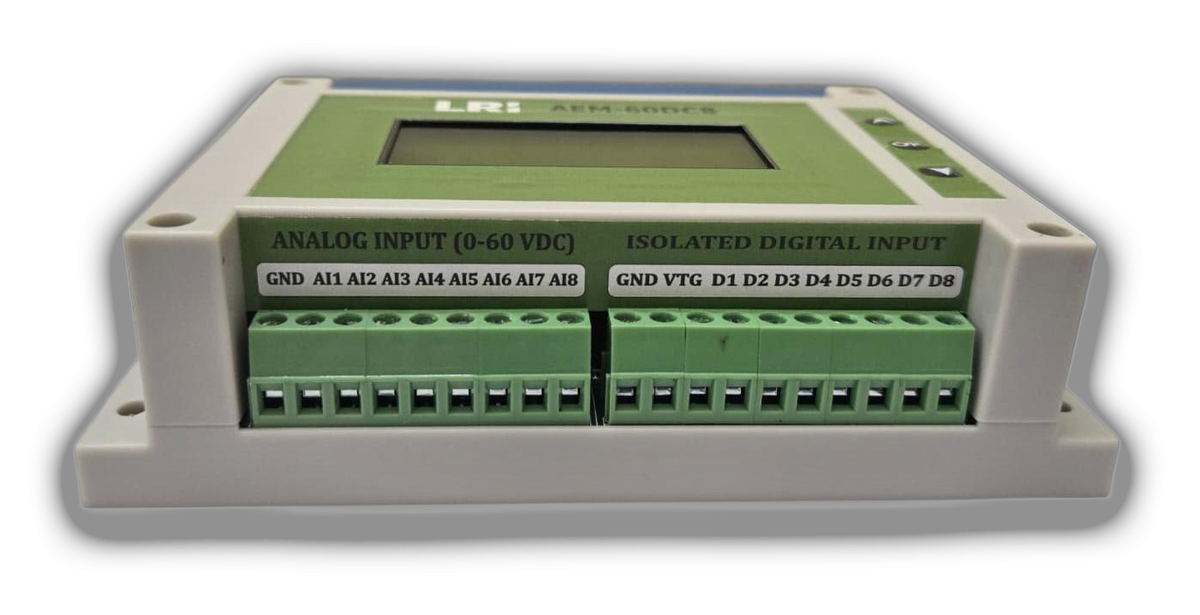
5000 VAC rms field-to-logic isolation across all 8 digital inputs.
Cell-by-cell supervision for 24V, 48V and high-voltage systems.
Rectifier and DC busbar monitoring across critical sites.
Direct integration with PLCs and SCADA via Modbus RTU.
DC output supervision in industrial power supplies and UPS.
Full compatibility with industrial supervisory systems.
String, bank and critical-energy monitoring.
Not generic electronics. Every block is sized to run inside an industrial panel 24/7.
Galvanic isolation on the 8 opto-isolated digital channels
ARM Cortex-M0+ @ 64 MHz
32-bit core with 512 KB flash and 144 KB SRAM dedicated to industrial firmware.
64 MB NAND + EEPROM
Persistent storage for operational logs and calibration parameters.
Battery-backed clock
Real-time clock with backup cell for reliable timestamping through power loss.
Fail-safe ±16 kV ESD
Transceiver with DIP-selectable 120 Ω termination and bias.
5000 VAC rms
8 opto-isolated digital inputs separating the field from control logic.
10–30 V DC, 60 V tolerant
Buck regulator + separate LDOs for the analog and digital 3.3 V rails.
Cybersecurity at the heart of engineering
The AEM-60DC8 ships with cybersecurity built into the firmware. Every layer — boot, update, telemetry — is engineered for environments where shop-floor control must never be compromised.
Ed25519 digital signature with our own domain-separation prefix. Master key in hardware (Yubikey) with up to 4 rotation slots.
Before accepting an image: magic word, version, CRC, hw_id, size, payload, vector table, end seal, signature.
TAMP counters with battery backup. Survive reset and power cycle. Saturate at 65,535.
The bootloader lives in a flash region the update channel never touches. Validation failure = update mode, never bricking.
Post-incident without cable, cloud or PII. Reset, HardFault, RTOS health, NACK reasons — all over Modbus.
Datasheets, manuals and Modbus map for system integrators and engineers.
One-page summary of the AEM-60DC8 technical and commercial highlights.
Full technical specifications of the LRI-AEM-60DC8.
Complete technical guide for installation, configuration and commissioning.
147 holding registers in 17 blocks, SCADA and PLC integration.
Python script that emulates an AEM-60DC8 slave so you can test your SCADA/PLC integration without the hardware.
In-depth technical materials on Modbus RTU, Secure by Design, battery banks and industrial cybersecurity — straight from LRI engineering.
Technical whitepaper on Modbus RTU for DC monitoring in telecom, solar and UPS — Secure by Design implementation in the LRI AEM-60DC8 (v1.03).
Technical whitepaper on design, monitoring and cybersecurity of 48V battery banks in distributed telecom sites. ANATEL, NMS, Modbus, SNMP.
Technical whitepaper for SCADA/PLC integrators: how to apply IEC 62443-4-2 SL2 in a real project, with acceptance checklist and AEM-60DC8 example.
Modbus RTU technical guide: frame, function codes, holding registers, RS-485, exception debugging, and industrial installation best practices.
Practical tutorial for building a Modbus RTU simulator in Python and validating SCADA integration with the AEM-60DC8 before the hardware ships.
Why Ed25519 digital signatures on firmware matter in industrial environments: attacks they prevent, chain of trust, signing ceremony and a checklist for PLC and HMI vendors.
Field guide for automation engineers sizing channels, voltage range, polling, isolation and environment of a DC monitor in a 24/7 industrial panel.
Technical comparison between Modbus RTU and Modbus TCP across physical layer, frame, latency, security, cost and real scenarios, with decision matrix and the role of the AEM-60DC8.
Modbus data types in practice: coils, discrete inputs, input registers and holding registers, addressing, function codes and real field pitfalls.
Sales and technical specialists reply within 1 business day.